Showing posts with label vintage fountain pen. Show all posts

Friday, October 30, 2020

The Savoy fountain pen

This one is quite an oddity for me. A vintage Savoy fountain pen in green marbled celluloid, British made, dating back to the late 1930s perhaps.

It sports a large 14kt gold, medium tipped, semi-flex nib. Very smooth writer. The barrel is in three sections:  the top half is a deep red/brown translucent ink window with a rubber sac or 'bulb' attached. The lower half can be screwed off and is in green marbled celluloid like the cap. There is a blind cap also which hides an aluminium button to fill ink, but I don't find it as effective as simply squeezing the sac directly.

The Savoy 'bulb' filler, uncapped
The Savoy 'bulb' filler

14 ct gold warranted nib

'Savoy British made' barrel inscription

Uncapped and 'bulb' exposed

Blind cap opened to show button filler mechanism


Wednesday, October 28, 2020

The Parker Televisor

Another Canadian Parker, a Televisor. A button filler fountain pen in striated green pattern and has a medium semi-flex stub 14k gold nib made in Canada. 

This was the first Parker model solely made in Canada, a very attractive mid-priced button filler model that was introduced in 1935. 

Made around 1935, I think, this is the MK I version, thought to have been named so because of the visible ink window in the barrel and the growing popularity of the new invention called the television! This being a button filler, I don't understand the need for the ink window, and was probably in the design because of the fad in those times.

The pen has three cap bands and rounded black ends. The Televisor MKI sports the ball ended clip, imprinted with "Parker" inside a raised, elongated diamond shape.


The Televisor's ink window at the beginning
of the section.


The Parker Premiere/Duette Sr.

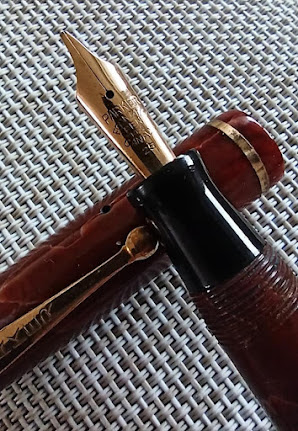
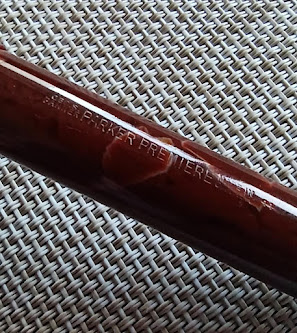
This is a depression era Parker Premeire (also known as the Parker Duette Sr. in the USA), manufactured in Canada sometime between 1932 and 1934. 

I believe these models were known as 'Thriftime' pens, coming after the great crash in 1929, when their flagship pens cost a lot. To save on manufacturing costs, Parker started manufacturing cheaper 'school pens'. 

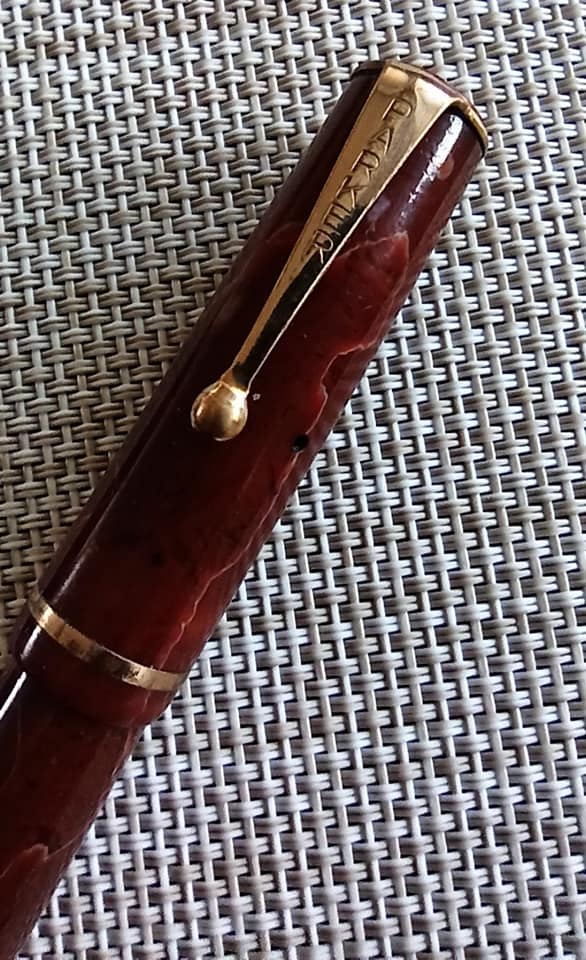
The Premiere/Duette Sr. has a flat, clip screw of the same material as the pen body and a Duofold style ball ended clip. It sports a single, narrow, gold filled cap band, a black section, a blind cap in the colour of the pen and was a button filler.

This particular colour is called Red Onyx, I think. The 14k Canadian nib has a little bit of flex and writes medium to broad, and very smooth.
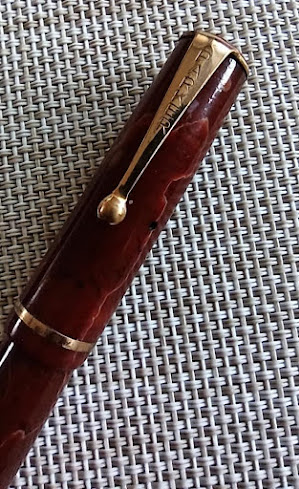
The Duofold style ball-end clip

Canadian 14k gold nib and a black section
 

Clear barrel imprint

Monday, July 29, 2019

The Guider Celluloid Conversion

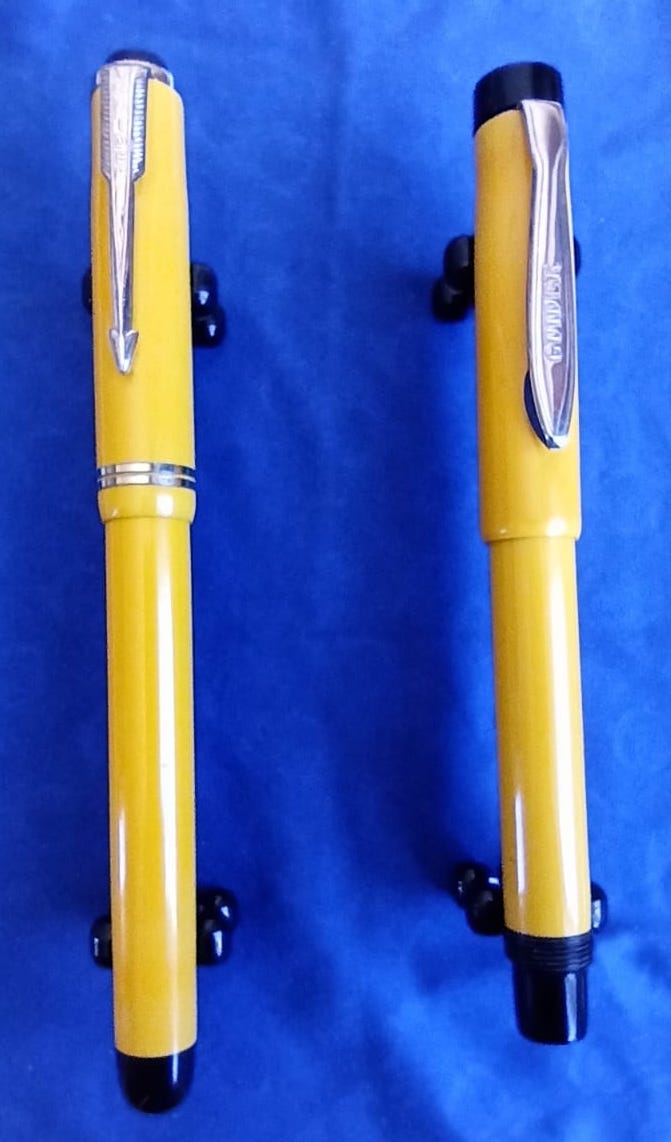
Guider Pen Works, Rjy, one of the oldest surviving fountain pen makers in India, was established in 1946 by Mr. G Subbarao. The company is now run by his son Mr. G Laxmana Rao. Till a short while back they still had vintage celluloid rods/tubes that the founder had imported all the way back in the late 1940s. 

During my visit in late 2017, I had broached this topic with Mr. Rao and he told me that all rod stocks had been used up and the finished and unfinished pens that he had were the last batch, comprising mainly of the yellow celluloid. Sometime before my visit I had already acquired a couple of these in the yellow celluloid material.

Sometime back I was informed that these pens made by Guider, were of that particular type of celluloid and that it degrades very fast, especially when in direct contact with ink, given its age and conditions of storage. This one being an eyedropper, would be at risk if it was used frequently.

Yusuf ji very kindly converted one of the pens to an aerometric filler early this year, and that inspired me to think how I could do the same for the other one.

This pen is a small one and a setup that is used by common Chinese pens would not fit, so I needed to construct something customized for this pen. The following pics illustrates my attempt. Please look at the pics and description attached to each of the images and follow the step-by-step process.

01  The Guider celluloid, the subject of my experiment. This material is apparently about 70-odd years old.
01. The Guider celluloid, the subject of my experiment. This material is apparently about 70-odd years old.

02 The pen uncapped.
02. The pen uncapped.

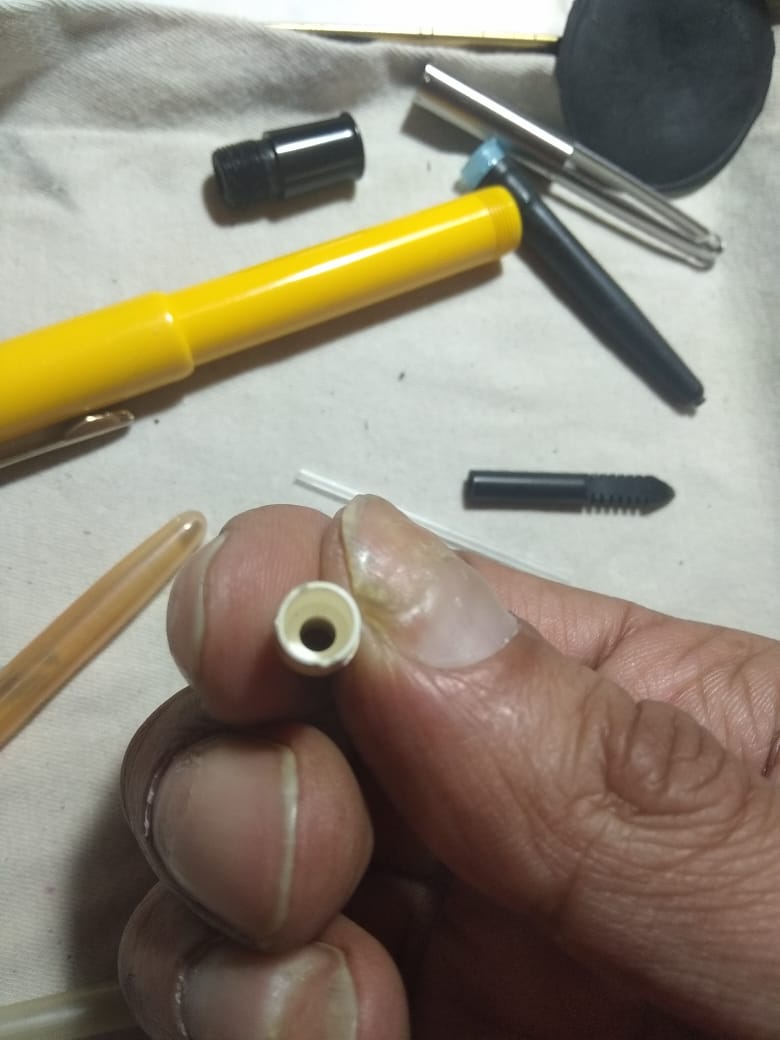
03. Finding a suitable part of an old ball pen for a makeshift nipple that will attach to the ebonite section on the inside.
04. The parts all lined up to illustrate how they will all come together.

05. The sac (taken from a cheap discarded Chinese pen) has been fitted to the plastic tube shown earlier.

06. The inner diameter of the section needs widening to accommodate the thinner end of the nipple. Coincidentally, the outer diameter of the nipple is the same as that of the feeder. I manually drilled with a suitable drill-bit, (very slowly!) until the white end was fitting snugly into the section.
07. Measurements were carefully taken to ensure minimum margin of error.

08. This shows the sac+nipple fitted into the section on the barrel side. The nipple needs to be shortened since it is a bit too long. I wanted to make sure that the aerometric unit was as short as possible.

09. The nipple cut to size.

10. The end sanded down to make sure there are no jagged edges. I used a 1500 grit sandpaper.
11. Ensuring that it's a snug with with enough space for the feeder to be installed.

12. All (ok, most) of the parts coming together.

13. I applied a bit of silicone grease to the edge between the section and the nipple to ensure a no-leak fit. The nipple is snug enough to require a certain bit of pressure to pull out from the section.

14. The outer metal jacket needed to be cut to the size of the sac. This part came from a Pilot converter. I used a hacksaw and rough sandpaper to smooth the edges.
15. All done! Now to see if it works!

16. It draws liquid! Success!


The following images were added in August 2020 as comparison between the two yellow Guider celluloids in my possession. 


Monday, January 21, 2019

Wahl Eversharp Doric

A vintage Wahl Eversharp Doric with a no. 5 adjustable nib.